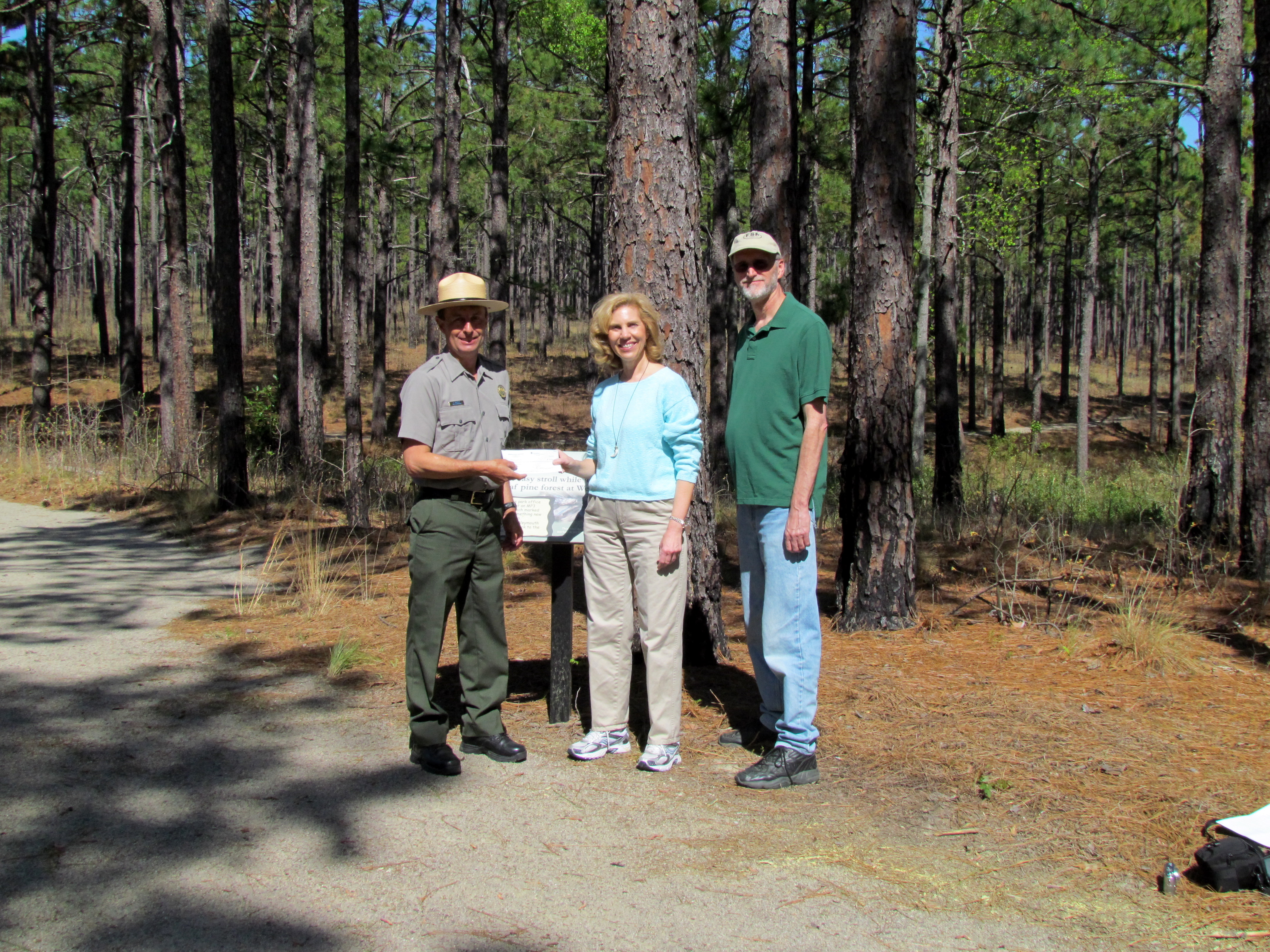
 Weymouth Woods-Sandhills Nature Preserve Superintendent Scott Hartley thanks Candace Williams, Executive Director of the Sandhills Area Land Trust (SALT), and Bob Sowa, Vice President of Friends of State Parks (FSP), for a grant to refurbish equestrian trails at the park.
FSP received a grant from the Sandhills Area Land Trust to upgrade and repair equestrian trails at Weymouth Woods. The trails have been badly eroded over years of heavy use and a shortage of maintenance funds. Candace Williams, of SALT said the grant was donated by members of the community who wished to see the trail repaired. Scott Hartley said the park is eager to begin work and the grant will enable the park to purchase the necessary trail material to support horse traffic and that the trail will be built by the staff with local volunteers. FSP was glad to be able to use their non-profit status and close relationship with the State Parks to handle the management of the grant funds for this project. All look forward to riders once again being able to ride in ease through this unique preserve of longleaf pines.
The Sandhills Area Land Trust is active throughout the region in helping land owners protect the land the land they love. Visit their web site at www.sandhillslandtrust.org to learn how they have helped both land owners and the environment and how you can assist them.
Friends of State Parks is a state wide non profit organization supporting North Carolina's state parks. FSP works closely with the Department of Parks and Recreation, local land trusts, local park friends groups, and corporate sponsors to help protect the parks natural resources for future generations and to provide educational, recreational, and visitor resources to local communities across the state. Go to www.ncfsp.org to join FSP in supporting your state parks. One of FSP projects is sponsoring North Carolina's State Parks Junior Ranger program for ages 6 thru 12. You can download the free Junior Ranger Guide for Weymouth Woods at www.ncparks.gov
Weymouth Woods is a special part of the park system, small in size but great in its diversity of plant life. It contains some of last vestiges of a longleaf pine forest that once dominated the east coast of North America. Besides the equestrian trail, the park offers easy walking trails ranging from short loops through the “pine barrens” to several miles of interconnected trails that take the explorer through the varied ecological regions of “pine barrens,” hard woods forests, and wetlands. An exhibit hall offers exhibits on the history of the area and the natural aspects of the park including geology, wildlife, and the role of prescribed fires. A list of the many educational and fun events scheduled in the park is available at www.ncparks.gov.
The park is also famed for its bird viewing including the red-cockaded woodpecker. The park staff and certified volunteers periodically attach bands on the different birds in the park as part of an international program to track bird population and locations to learn how to better protect them against the trials of an ever challenging world. The park also sponsors two annual Audubon Bird Counts that are open to all birders.
Weymouth Woods-Sandhills Nature Preserve is just two miles east of Southern Pines and is an easy drive from both Fayetteville and the Raleigh Durham area and even closer to the famed golf resorts of Pinehurst and Southern Pines. Make your plans now to visit Weymouth Woods-Sandhills Nature Preserve.
